How to Prepare for Case Study Interviews and Succeed
Preparing for a case study interview really boils down to three things: building a solid foundation of business knowledge, practicing consistently, and polishing your executive presence. If you can nail these three areas, you'll show the kind of analytical skill and confidence that top firms are looking for.
What Recruiters Actually Look For in a Case Interview

Before you start memorizing frameworks, it’s critical to understand why firms like McKinsey, BCG, and Bain use case interviews in the first place. They aren't looking for human calculators. They're looking for future business leaders.
The case is just a simulation. It’s designed to see how you think, communicate, and act when you’re thrown a messy, ambiguous business problem—the same kind their consultants face every single day.
Let's be clear: the competition is brutal. Acceptance rates at top consulting firms often fall to less than 1%. This reality has pushed candidates to prepare harder than ever, with many spending over 100 hours and enrolling in specialized courses just to get an edge. You can read more on the evolving prep landscape over at strategyu.co.
This intense environment means your prep can't be random. It has to be targeted directly at what recruiters are actually scoring you on. And it’s a lot more than just getting the "right" answer.
Beyond the Correct Answer
So many candidates get this wrong. They think the goal is just to solve the case. While you do need a logical conclusion, the interviewer is way more interested in how you get there.
They’re watching you closely, looking for a few core competencies that signal your potential as a consultant.
Recruiters are mainly looking for:
Structured Thinking: This is the big one. Can you take a huge, messy problem and break it down into clean, logical pieces?
Business Intuition: Do you have a good gut feeling for how businesses work? Can you make smart assumptions and pinpoint what really matters?
Communication and Poise: How do you sound when you’re under pressure? Are you clear, confident, and easy to follow?
Coachability: What happens when the interviewer gives you a hint? A candidate who can take feedback and run with it is showing a key skill for working on a team.
The case interview is a dialogue, not a monologue. How you engage the interviewer, ask smart questions, and adapt your thinking on the fly is just as important as the framework you pick.
The Real-World Simulation
Think of the case as a mini-consulting project. The interviewer is your client. They give you the initial problem and some data. Your job is to be the consultant and lead them through the problem-solving process.
This setup is designed to see if you can drive the conversation forward logically. For instance, if you're asked about a market entry strategy, a weak candidate will just list some pros and cons. A strong candidate, on the other hand, will structure their thoughts around key pillars—like market size, competition, client capabilities, and financial return—and walk the interviewer through each one.
To give you a clearer picture, here’s a breakdown of what recruiters are looking for and how you can show them you've got it.
Core Competencies Assessed in Case Interviews
The table below breaks down the key skills that are being evaluated during a case interview. It's not just about what you know, but how you demonstrate it under pressure.
Competency | What It Means | How to Demonstrate It |
|---|---|---|
Problem Structuring | Your ability to create a logical, comprehensive framework to analyze the core issue. | Verbally lay out your approach at the beginning. Use a MECE (Mutually Exclusive, Collectively Exhaustive) structure. |
Quantitative Acumen | Your comfort with mental math, estimations, and data interpretation to drive insights. | Think out loud during calculations. Explain the "so what" of your numbers, not just the result. |
Communication Skills | Your clarity, conciseness, and professional demeanor throughout the interview. | Maintain eye contact, use a confident tone, and synthesize your findings clearly at the end. |
Creativity & Insight | Your capacity to move beyond the obvious and connect disparate pieces of information. | Offer unique ideas or identify second-order effects of a potential recommendation. |
Ultimately, what matters is showing the interviewer you have the raw analytical horsepower and professional maturity to be a trusted advisor to clients. The rest of this guide will give you a step-by-step plan to build these exact skills.
Building Your Business Acumen and Quantitative Skills
A killer case interview performance doesn’t come from memorizing a dozen frameworks. It’s built on something much deeper: a solid foundation of business intuition and quick, confident quantitative analysis.
This is where you stop acting like a student and start thinking like a consultant. Success isn't about reciting Porter's Five Forces; it’s about knowing how to apply its principles to a messy, real-world problem you’ve never seen before. It’s about having the core business and financial knowledge to make logical assumptions and calculations when the pressure is on.
Developing Real Business Intuition
Think of business acumen as your internal compass for how industries actually work. It’s the ability to quickly size up a company's business model, get a feel for its biggest cost drivers, and spot how it makes money. You don't need a decade of C-suite experience to build this—you just need to be a curious, active observer of the world around you.
Start by deconstructing the companies you see every day:
Your Coffee Shop: How are they really making money? Is it the sheer volume of drip coffee, the high margins on fancy lattes, or upselling pastries? What are their biggest bills—rent, barista salaries, or the cost of coffee beans?
A Streaming Service: What’s their core model? Subscriptions, ads, or a mix? Who are they really fighting against for your screen time? What’s the single biggest threat to their bottom line?
An Airline: Why is this a famously tough, low-margin business? What are the massive fixed costs (planes, airport gates) versus the variable ones that change with every flight (fuel, crew)?
This isn't just a thought exercise. This daily practice trains your brain to see the mechanics behind the curtain. It’s a skill that will feel like second nature when you’re asked to diagnose why a fictional company’s profits are tanking in the middle of an interview.
Your goal isn't just to understand financial statements, but to interpret them. A great candidate sees a declining gross margin and immediately starts asking why. Is it rising material costs? Are competitors forcing them to slash prices? Or did they start selling more of their lower-margin products?
To sharpen this skill, you absolutely need a firm grasp on financial fundamentals. Knowing how revenue, costs, and profits flow through a business isn't optional. If you need a refresher, our guide on walking through the 3 financial statements breaks it down simply and clearly.
Mastering Mental Math and Key Statistics
While business sense tells you what to look for, your quant skills tell you how much it matters. In a case interview, you won't get a calculator. Your ability to do quick mental math and market sizing is your ticket to proving your analytical horsepower.
This isn’t about advanced calculus; it's about being comfortable with big numbers, percentages, and basic arithmetic. The name of the game is speed and accuracy. Can you quickly calculate a 20% increase on $1.5 million? Or figure out the break-even point for a new product launch?
The stats you need are practical, not theoretical. You're expected to know key demographic and economic numbers to make reasonable, back-of-the-envelope assumptions. This includes big-picture figures like the world population (8 billion people), an average household size (2.5 individuals), and an average life expectancy (80 years). You also need country-specific data locked and loaded, like the populations of the United States (320 million), China (1.4 billion), and India (1.4 billion), as well as major cities like New York City (8.9 million), Los Angeles (3.9 million), and Chicago (2.8 million). You can find more of these essential figures and why they are so critical for consulting interviews.
Practical Drills to Sharpen Your Skills
Theory is useless without practice. To build the muscle memory you need for case day, weave these drills into your daily routine.
1. Market Sizing on the Go Turn everyday observations into quick market sizing problems. Waiting for the bus? Estimate the annual revenue of the city's bus system. In a grocery store? Calculate the weekly revenue for the dairy aisle.
Example Drill: Estimate the annual market size for electric scooters in Chicago.
Your Thought Process: Start with Chicago's population (~2.8M). Segment it (e.g., age, likelihood to use a scooter). Estimate the number of potential riders, then guess the frequency of rides and the average cost per ride. Boom.
2. Quick and Dirty Break-Even Analysis Pick a product you see and run a fast break-even calculation in your head.
Example Drill: A new coffee shop has fixed monthly costs of $10,000. The average price per coffee is $5, and the variable cost per coffee is $1.
Your Calculation: The contribution margin is $4 per coffee ($5 - $1). To cover fixed costs, they need to sell $10,000 / $4 = 2,500 coffees per month.
3. Percentage and Growth Calculations Get comfortable calculating percentages and growth rates with big, messy numbers.
Example Drill: A company's revenue grew from $250 million to $300 million. What was the percentage growth?
Your Calculation: The increase is $50 million. So, the growth rate is ($50M / $250M) = 1/5 = 20%.
Doing these little exercises consistently will make the quantitative part of the case feel like second nature. That frees up your mental energy to focus on what really sets you apart: the strategic insights.
Your 8-Week Case Interview Preparation Timeline
Staring down the mountain of prep for a case interview can feel overwhelming. I've been there. The best way to tackle it isn't by randomly grinding cases but by following a structured plan that builds your skills week by week. An eight-week timeline is a sweet spot—enough time to go from zero to a polished, confident performance without burning out.
Think of this as a training plan. Serious candidates typically put in 4-12 weeks of prep, with many dedicating two to three hours a day in the final month. Starting 6-8 weeks out is ideal. Most people begin by reading the bibles of case prep: Case in Point and the Vault Guide to the Case Interview. These are non-negotiable first steps.
To help you get organized, here’s a sample study plan that breaks down the eight weeks into manageable phases.
A Sample 8-Week Case Interview Study Plan
This schedule is designed to take you from foundational knowledge to interview-ready confidence, focusing on a new skill set every couple of weeks.
Weeks | Primary Focus | Key Activities |
|---|---|---|
1-2 | Mastering the Fundamentals | Reading key texts (Case in Point, etc.), building a stats cheat sheet, and running daily market sizing and profitability drills. No full cases yet. |
3-5 | Active Solo & Peer Practice | Working through cases out loud by yourself, recording your thought process, and then starting partner mocks. Aim for 3-5 partner cases per week. |
6-7 | Pressure Testing & Refining | Simulating real interview conditions (timed, formal). Identifying and drilling your specific weaknesses (e.g., market entry, creative questions). |
8 | The Final Polish | Light review only. Focus on confidence-building, rereading positive feedback, and doing one or two friendly mocks to stay sharp. Avoid cramming. |
This timeline ensures you build skills logically, rather than jumping into the deep end without knowing how to swim.
Weeks 1-2: Mastering the Fundamentals
Your first two weeks are all about building the foundation. Seriously, don't even think about a full, timed mock interview yet. The goal here is just to learn the language and logic of case studies.
Focus on absorbing the core concepts. Read the essential books to understand the basic frameworks—not so you can recite them like a robot, but so you grasp the business problems they were designed to solve.
Read the Essentials: Get through Case in Point and the Vault Guide. Pay close attention to how they break down complex problems into logical pieces.
Build Your Stats Cheat Sheet: Start memorizing those key population figures, economic data points, and common business metrics.
Drills, Not Cases: This is critical. Focus only on market sizing and profitability drills. Do five to ten every single day to get your mental math and estimation skills up to speed.
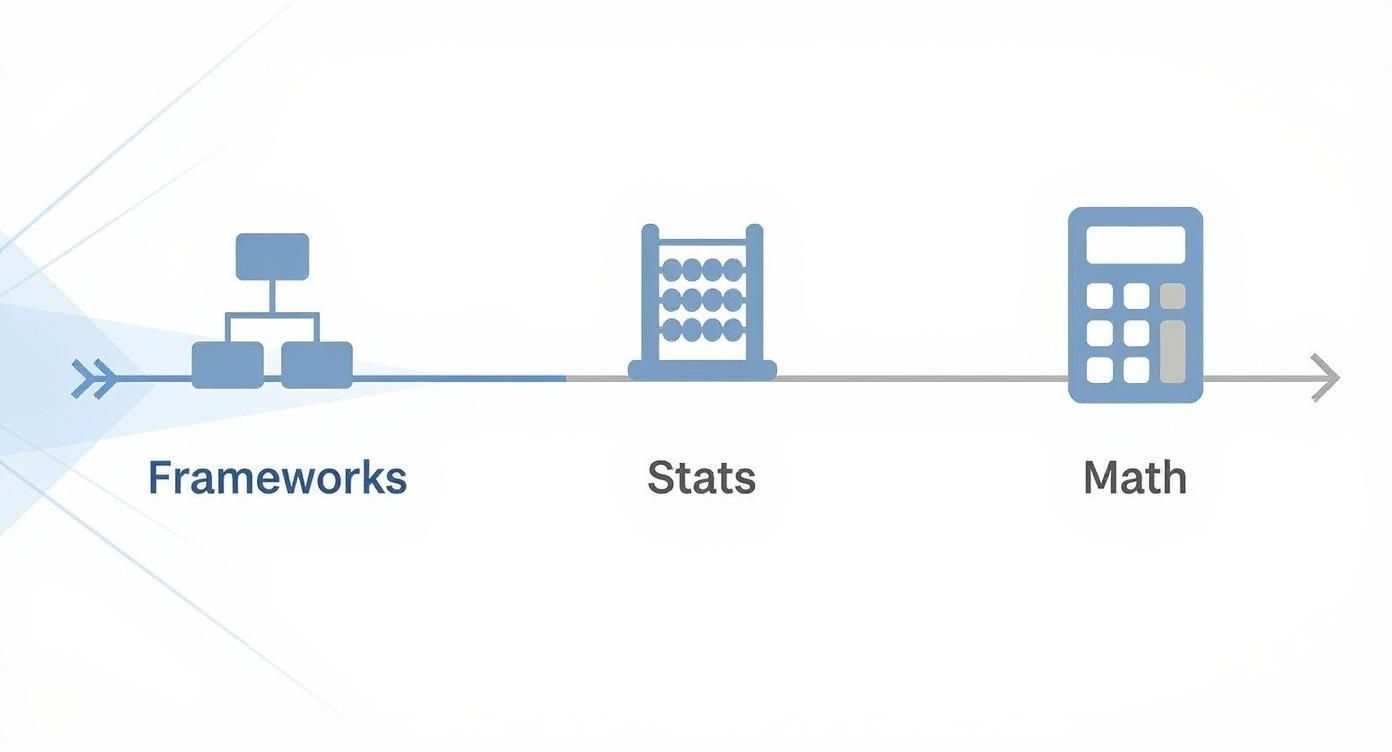
This phase is about moving from theory (frameworks) to application (stats and math), building a solid base before you ever see a full case.
Weeks 3-5: Shifting to Active Practice
Okay, now it's time to get your hands dirty. We're moving from passive learning to active problem-solving. This is where you get your reps in, first on your own and then with a partner.
Start by doing cases solo. Grab a written case, talk through your logic out loud, and structure your response on a whiteboard or a piece of paper. You're not aiming for speed yet—you're aiming for clarity of thought. Try recording yourself; it’s painful but incredibly effective for catching awkward phrases and logical holes.
By week four, start doing peer-to-peer mocks. Find partners through your university clubs or online case prep platforms. The key here is finding people who will give you blunt, constructive feedback, not just someone who tells you you’re doing great.
A great practice partner is better than a dozen mediocre ones. Look for someone who challenges your assumptions and forces you to defend your logic. This is where real growth happens.
During this period, you should be knocking out three to five partner cases per week. And remember, the debrief is just as important as the case itself. Spend just as much time discussing what went right and wrong.
Weeks 6-7: Pressure Testing and Refining
These two weeks are about one thing: simulating the real deal to hunt down your weaknesses. Your mock interviews should now be as realistic as you can make them. Dress the part, set a strict timer, and treat your partner like they’re the Managing Director you want to work for.
Start looking for patterns in your performance. Do you consistently fumble creative questions? Does your math get sloppy under pressure? Is your final recommendation always a bit weak?
Targeted Drills: If you find a weak spot, dedicate entire sessions to it. If market entry cases are giving you trouble, do five of them back-to-back until they feel like second nature.
Advanced Cases: Start seeking out those tricky, ambiguous cases that don't fit neatly into a standard framework. This is what tests your ability to think on your feet and build custom structures.
This is also the perfect time to dig deeper into our guide on investment banking interview prep to make sure every other aspect of your candidacy is just as polished.
Week 8: The Final Polish
The final week is not for learning anything new. It's about building confidence and getting your head in the right space.
Do one or two light, friendly mock interviews just to stay sharp, but avoid the temptation to grind. Instead, spend your time reviewing your notes. Reread the feedback from your best mocks. Remind yourself how far you've come.
Walk into that interview calm and prepared, ready to have an intelligent conversation. You’ve earned it.
Getting the Most Out of Mock Interviews
Reading about frameworks is just the warmup. Watching case walkthroughs is helpful, sure. But the real progress—the kind that lands you an offer—only happens when you step into the ring and feel the pressure of a live interview. Mock interviews are where theory gets tested by reality.
But just going through the motions is a waste of time. I’ve seen countless candidates do dozens of mocks without getting any better. Why? Because they treat them like a casual chat instead of a high-stakes simulation. To actually improve, every session needs the structure and intensity of the real thing.
That means creating a realistic environment, giving and receiving brutally honest feedback, and tracking your progress like a hawk. Done right, mock interviews are the single most important thing you can do to prepare. They expose your blind spots before an actual interviewer does.
Creating a Realistic Simulation
The whole point of a mock is to replicate the interview as closely as possible. You’re building muscle memory so you can stay calm and structured when it actually counts.
So, set the scene. Find a quiet spot where you won’t be disturbed. Dress the part. It might feel silly, but putting on the suit flips a mental switch into a professional mindset. And please, use a timer. You have to get used to thinking clearly under the pressure of a ticking clock.
Your practice partner is everything here. Find someone who will actually commit to the role—someone who will challenge your assumptions and maintain a professional, sometimes skeptical, demeanor. The more realistic the pressure, the better you’ll be on game day.
A huge mistake is only practicing with people you're comfortable with. Friends are great, but they often give polite, unhelpful feedback. You need to seek out partners who aren't afraid to tell you your math was sloppy or your final recommendation was weak.
The Art of Giving and Receiving Feedback
Honestly, the feedback session is probably more important than the mock itself. Vague comments like "good job" are completely useless. You need specific, actionable critiques that pinpoint exactly where you went wrong and what to do differently.
When you're the one giving feedback, be specific:
On Structure: "Your initial framework was solid, but you never really came back to it. It felt like you were just chasing random data points instead of following a logical path."
On Quants: "Your market sizing math was right, but you didn't explain the 'so what' of the $500M number. What does that actually mean for the client's decision?"
On Communication: "I counted 12 filler words like 'um' and 'like' in the first five minutes. It really hurt the confidence you were trying to project."
When you're on the receiving end, your only job is to shut up and listen. Don't get defensive. Don't make excuses. Just take detailed notes, ask clarifying questions, and thank your partner for being direct. This is how you find the bad habits that are holding you back.
The Self-Assessment Scorecard
After every single mock, you need to grade yourself with an objective scorecard. This forces you to be honest about your weaknesses and lets you track improvement over time. It shifts you from a vague feeling of "that went okay" to a data-driven view of your skills.
Here’s a simple template to get started. Rate yourself from 1 (Needs Significant Work) to 5 (Flawless Execution).
Category | Sub-Skill | Your Score (1-5) | Specific Notes for Improvement |
|---|---|---|---|
Structure | Initial Framework | 3 | My framework was too generic. Need to tailor it to the specifics of the prompt next time. |
Analysis | Quantitative Rigor | 2 | Made a calculation error under pressure. Need to slow down and double-check my math out loud. |
Communication | Synthesis & Recommendation | 4 | My recommendation was clear, but I could have tied it back to my initial framework more strongly. |
Poise | Confidence & Presence | 3 | Fidgeted with my pen when I got stuck. Need to practice pausing and thinking calmly. |
This self-evaluation process is what turns practice into real, tangible improvement. Don't skip it.
Using AI for High-Volume Practice
Let’s be real: finding quality human partners for daily mocks is tough. That’s where AI tools can be a game-changer for your prep.
Platforms like AskStanley let you run through unlimited mock interviews and specific drills whenever you want. The AI can give you instant, objective feedback on your structure, communication, and analysis without the scheduling headache. It's perfect for getting in a high volume of reps to iron out the kinks in your delivery.
While AI can’t fully replace the nuance of a human interviewer, it’s an incredible tool for accelerating your mastery between peer sessions. For more ideas on integrating these tools, check out our in-depth interview skills practice guide.
But here’s the ultimate secret: record yourself. It’s painful to watch, I know. But it's the fastest way to spot your own filler words, analyze your body language, and hear exactly how you sound to an interviewer. Record, review, and refine. Do this until your delivery is as polished as your analysis.
How to Avoid Common Case Interview Traps
Even the sharpest candidates can absolutely bomb a case interview. It's almost never about raw intelligence. It’s about falling into predictable, totally avoidable traps under pressure. Prepping for a case study isn’t just about what you know; it’s about knowing what not to do when the clock is ticking.
These common mistakes instantly signal to an interviewer that you lack the structured thinking or business judgment needed for the job. Recognizing them is step one. Actively drilling the tactics to sidestep them is what will put you ahead of the pack.
Sidestepping the Framework Dump
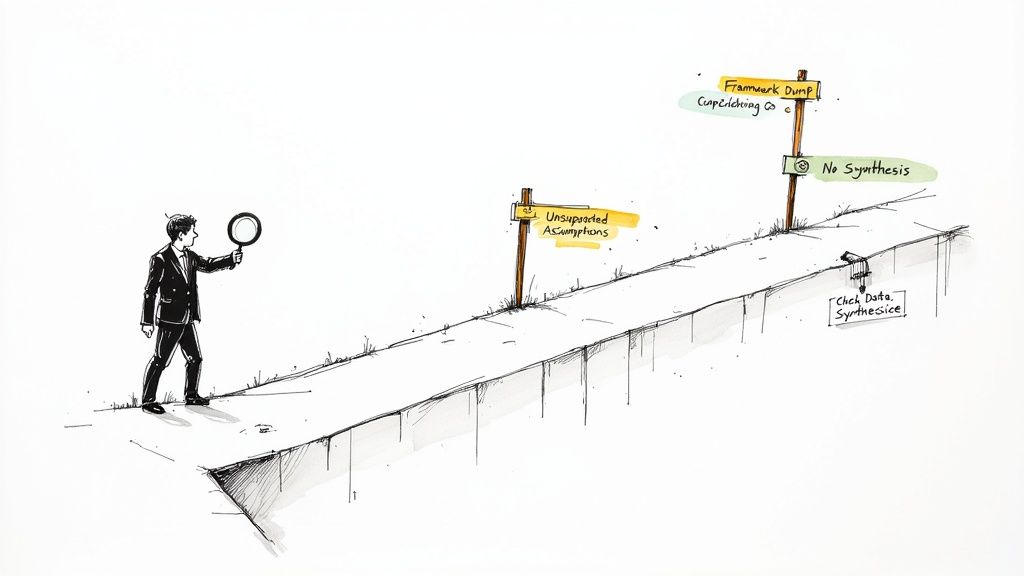
This is probably the most common trap out there: the dreaded "framework dump." A candidate hears a buzzword like "profitability," and they immediately start reciting a textbook framework without thinking if it actually fits the problem. It screams, "I memorized this, but I can't think for myself."
Forget force-fitting a generic structure. Instead, take a beat and build a custom approach on the fly. A really effective way to do this is to lead with a hypothesis. For example, if a company’s profits are tanking, you could say: "My initial hypothesis is that the profit decline is being driven by rising input costs for their main product, not a drop in sales volume."
That one simple shift changes the entire interview. You're no longer a robot reciting a script; you're a proactive problem-solver leading the investigation.
Making Assumptions Without Validation
Another classic error is making assumptions and then treating them like facts. Candidates do this all the time to simplify a problem, but if you don't state and test those assumptions, your entire analysis is built on a house of cards.
Top-tier candidates make their assumptions explicit and then immediately try to validate them. They treat the interviewer like a partner, asking smart, clarifying questions to shore up their logic.
Here’s how you do it right:
State Your Assumption Clearly: "To size this market, I'm going to assume the population of New York City is roughly 9 million. Is that a reasonable number to use for this exercise?"
Explain Your Logic: "I'm assuming our client has access to the same distribution network as its main competitor. That seems likely given their similar scale, but it's a critical factor I'd want to confirm."
Identify High-Impact Assumptions: Know which assumptions, if wrong, would blow up your entire recommendation. You should flag this risk in your final summary.
Your ability to think out loud is your greatest asset. It’s not just about getting the answer; it’s about showing the interviewer how you get there. Verbalize your structure, your math, and especially your assumptions.
Forgetting the Crucial "So What?"
So many candidates get lost in the weeds of the math that they forget the most important part: the "so what?" They’ll nail a calculation, figure out a market is worth $500 million, present the number… and then just stare at the interviewer, waiting for what’s next.
That's a huge missed opportunity. Every piece of data you calculate should be followed by an insight that drives the case forward.
After you run a number, immediately explain what it means. For example: "The market size is $500 million. Given our client is targeting 10% market share within three years, this confirms the market is absolutely large enough to be an attractive opportunity." This ties your quantitative work directly to the client's actual goals.
Delivering a Weak Conclusion
The last trap is a weak, meandering conclusion. After 20 minutes of solid analysis, a candidate will just summarize their findings without making a firm, data-backed recommendation. It leaves the interviewer completely underwhelmed.
Your conclusion is your closing argument. It has to be crisp, confident, and directly answer the original question. A strong final recommendation always has three parts:
A Clear Stance: Start with a direct answer. "Based on my analysis, I recommend the client should enter the UK market."
Supporting Arguments: Briefly hit the 2-3 key findings from your analysis that back up your conclusion.
Next Steps: Suggest the immediate next steps the client should take to either implement your recommendation or de-risk the plan.
Mastering these avoidance tactics moves you from just participating in the case to actively leading it—and that’s exactly what interviewers are looking for.
Your Top Case Interview Prep Questions, Answered
Even with the perfect study plan, you're going to have questions. The kind of practical, "what-if" stuff that most prep guides just gloss over. Let's tackle the big ones I hear all the time so you can keep your prep focused and effective.
How Many Practice Cases Should I Really Do?
There’s no magic number here, but the sweet spot for most successful candidates lands somewhere between 30 to 50 high-quality cases.
And the keyword is quality. It's far better to do 30 cases where you spend real time on the debrief—figuring out what went wrong and what went right—than to just blaze through 60 without learning a thing.
The goal isn't hitting some arbitrary number. It's about getting comfortable with different case types (profitability, market entry, M&A) so you can confidently structure whatever problem gets thrown at you on interview day.
Where Can I Find Good Practice Partners?
This one is critical. The right partners can make or break your prep. Your first stop should always be your university’s consulting clubs or career services. They're full of people who are just as motivated as you are.
Outside of campus, there are some great online platforms. The key is to find partners at your skill level or slightly above. You want someone who will give you honest, direct feedback, not just tell you what you want to hear.
Pro Tip: Don't just practice with one person. Working with a variety of partners is a huge advantage. It forces you to get used to different interviewing styles and adapt your communication on the fly—exactly like you'll have to do in the real thing.
Should I Use AI Tools to Help Me Prepare?
Absolutely. But think of them as a supplement, not a replacement for human practice.
AI is fantastic for high-volume drills and getting instant feedback. Got a spare 30 minutes? Run a few framework drills with an AI partner to build that muscle memory. It’s perfect for reps when you can’t schedule a session with a live person.
But you still need that human element. You can't replicate the pressure of a real-time interview or get truly nuanced feedback on your presence and soft skills from a machine. The best approach is a mix: use AI for high-frequency practice and save your human partners for high-fidelity, full-blown mock interviews.
What Should I Do If I Get Stuck During a Case?
First thing: breathe. It happens to literally everyone. The interviewer isn't looking for perfection; they want to see how you handle pressure. Getting stuck is a test of your poise.
The best move is to take a quick pause and verbally recap what you know. You can say something like, "Okay, let me just summarize where I'm at. I've analyzed the revenue side and the cost structure, and now I'm thinking through the competitive landscape to pinpoint the root cause."
This does two things: it shows the interviewer you're still thinking in a structured way, and it often helps you spot the connection you were missing. It's also totally fine to ask for a moment to gather your thoughts or to ask a sharp, clarifying question to get back on track.
Ready to stop guessing and start mastering the case interview? AskStanley AI gives you unlimited, realistic mock interviews and adaptive drills to sharpen your skills. Walk into your interviews with total confidence. Start your path to an offer today at https://www.askstanley.ai.