8 Perfect Investment Banking Resume Example Templates for 2025
Your resume has less than seven seconds to convince an investment banking recruiter you are worth an interview.Your resume has less than seven seconds to convince a recruiter you're worth a six-figure salary. For aspiring investment bankers, this isn't just a piece of paper-it's your ticket to one of the most competitive industries on the planet. The margin for error is effectively zero. A single formatting mistake, a weak bullet point, or a failure to quantify your impact can send your application straight to the rejection pile. Generic templates and vague descriptions simply won't cut it.
This guide moves beyond the basics to provide a strategic blueprint for crafting a resume that commands attention. We will dissect eight distinct investment banking resume example templates, covering a wide range of candidate profiles:
The hungry undergraduate intern aiming for a full-time analyst offer.
The experienced analyst and associate looking to move up or lateral.
The seasoned Vice President targeting a senior role.
The strategic career-changer breaking into the industry.
For each example, we will provide concrete before-and-after bullet point transformations, breaking down the exact language and quantified metrics that get you noticed. You'll learn the precise formatting that navigates Applicant Tracking Systems (ATS) and appeals to human reviewers. We'll also provide actionable strategies and downloadable snippets you can directly apply. Get ready to transform your resume from a hopeful application into a powerful, interview-generating asset that clearly demonstrates your value.
1. Analyst (1st Year) Investment Banking Resume
The first-year Analyst resume is the quintessential entry point into the world of high finance. This document is your primary marketing tool when you have limited full-time work experience, designed to convince recruiters you have the raw talent, academic horsepower, and relentless work ethic to succeed. This type of resume, a classic investment banking resume example for aspiring financiers, strategically places education at the forefront, followed by highly relevant internship experience.
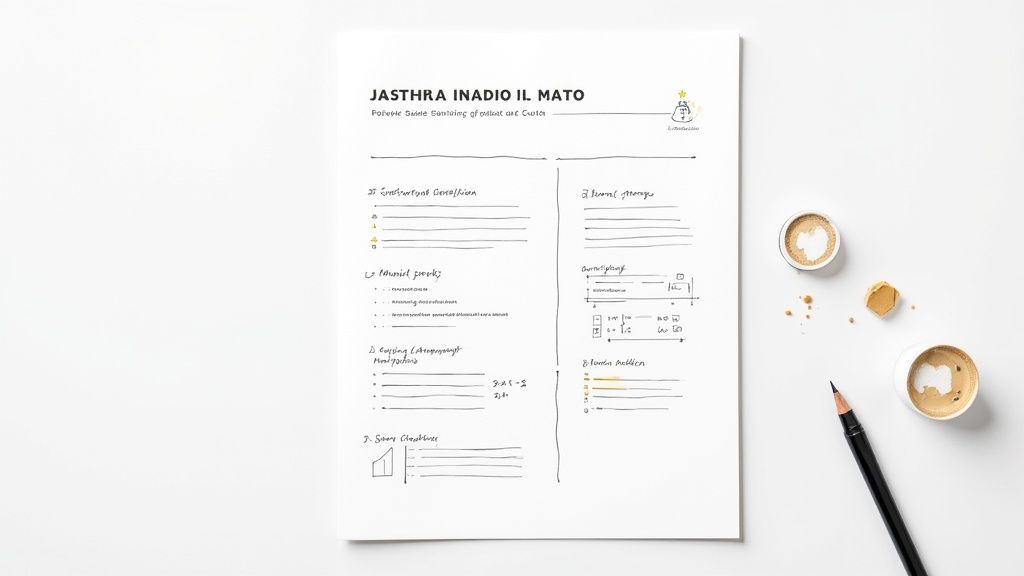
This format is the standard for candidates targeting prestigious programs like the Goldman Sachs New Analyst Group or those converting a JPMorgan Summer Analyst internship into a full-time offer. Its structure is purpose-built to pass the infamous “30-second scan” by showcasing your most compelling qualifications immediately.
Why This Format Works
For an analyst candidate, potential trumps a long track record. Recruiters are screening for specific signals of success: a high GPA from a target school, quantitative coursework, and any hands-on financial modeling or valuation experience.
Prioritizes What Matters: Placing your education section first, especially if you attend a target or semi-target university with a strong GPA (3.7+), immediately establishes your credentials.
Highlights Relevant Experience: Internships, even in related fields like corporate finance or private equity, are positioned as the core of your experience section.
Demonstrates Technical Aptitude: A dedicated skills section featuring proficiency in Excel, financial modeling, and platforms like FactSet or Bloomberg is non-negotiable. This section is also a great place to showcase your foundational knowledge; for instance, being able to articulate a deep understanding of how to walk through the three financial statements is a critical interview skill your resume should allude to.
Actionable Tips for Your Analyst Resume
To make your resume stand out, focus on quantification and specificity.
Strategic Insight: Every bullet point should answer the "so what?" question. Instead of saying you "worked on a pitch deck," describe the outcome: "Developed slides for a $250M sell-side M&A pitch deck by analyzing industry comparables and precedent transactions."
Quantify Everything: Use numbers to frame your accomplishments. Mention the size of deals you worked on ($500M LBO), the number of companies you analyzed (25+), or the ranking of your case competition team (Top 5 out of 100 teams).
Use Powerful Action Verbs: Start each bullet with strong verbs like "Analyzed," "Modeled," "Valued," "Developed," and "Presented."
Keep it to One Page: This is a strict rule in investment banking. Brevity demonstrates your ability to synthesize and prioritize information, a key skill for any analyst.
2. Senior Analyst (2-3 Years) Investment Banking Resume
The Senior Analyst resume marks a critical pivot from potential to proven performance. After two to three years in the trenches, this document is no longer about academic promise; it's a testament to your deal execution capabilities, technical mastery, and industry knowledge. This investment banking resume example is tailored for analysts seeking to lateral to another firm, move up to a boutique, or solidify their path to an Associate promotion. Experience, not education, now takes center stage.
This format is essential for candidates targeting opportunities at elite boutiques like Evercore or Moelis, or for those moving from a large bulge bracket to a more specialized industry group. The resume’s architecture is designed to immediately communicate your value through tangible deal experience and quantifiable contributions.
Why This Format Works
For a senior analyst, recruiters and headhunters are looking for a plug-and-play professional who can hit the ground running. They screen for deal volume, transaction complexity, and the ability to operate with increasing autonomy.
Prioritizes Deal Experience: Your "Professional Experience" section moves to the top, directly under your contact information. Each role should feature a sub-section dedicated to "Selected Transaction Experience."
Highlights Industry Expertise: Your resume should clearly state the industry groups you've covered (e.g., TMT, Healthcare, Industrials), showcasing specialized knowledge that is highly valued.
Demonstrates Advanced Technical Skills: Beyond basic modeling, recruiters expect proficiency in complex LBO and M&A models. Your resume should signal this expertise and your readiness to handle the four types of technicals you will get asked in an interview with confidence.
Actionable Tips for Your Senior Analyst Resume
To elevate your resume, focus on ownership, impact, and mentorship.
Strategic Insight: Frame your bullet points around your specific role in the deal process. Instead of "Assisted on an M&A transaction," specify "Managed the data room and created a three-statement operating model for a $750M sell-side engagement in the software sector."
Quantify Your Deal Sheet: Aggregate your transaction experience. Include the total value of deals you've worked on (e.g., "Advised on over $3B in aggregate M&A transaction value").
Showcase Mentorship: Including a bullet point like "Trained and mentored two first-year analysts on financial modeling and pitch book creation" demonstrates leadership potential, a key trait for associate-level roles.
Be Specific About Your Contributions: Detail your involvement. Did you build the merger model from scratch? Did you lead client diligence calls? Highlight responsibilities that show you were more than just a supporting analyst.
3. Associate (MBA-Level) Investment Banking Resume
The Associate resume marks a pivotal transition from junior execution to a role demanding leadership, client management, and advanced technical skills. This resume is crafted for MBA graduates from top-tier programs or experienced Analysts (3+ years) being promoted. It strategically blends pre-MBA work experience with the academic and leadership credentials gained during business school, creating a powerful narrative of professional maturity and deal-making capability. This type of investment banking resume example is essential for candidates targeting roles like a Morgan Stanley Technology Banking Associate or a post-MBA hire at a bulge bracket firm.
This format signals to recruiters that you are no longer just an analyst focused on Excel and PowerPoint. It demonstrates you have the polish, industry knowledge, and leadership potential to manage deal teams and begin interfacing directly with clients, a key expectation for an Associate.
Why This Format Works
For an MBA-level candidate, the resume must prove you can add immediate value beyond raw analytical ability. Recruiters are looking for evidence of project management, client-facing experience, and a deeper strategic understanding of transactions.
Blends Experience and Education: The format places professional experience first, showcasing your track record, followed by your prestigious MBA education. This highlights a career progression that is enhanced, not defined, by the MBA.
Highlights Leadership and Management: Bullets should focus on managing analysts, leading workstreams, and presenting to senior bankers or clients. This demonstrates your readiness to take on the greater responsibilities of an Associate.
Emphasizes Transactional and Client Exposure: It moves beyond describing tasks to showcasing your role in the deal process. Highlighting experience with live transactions and any client interaction is critical.
Actionable Tips for Your Associate Resume
To elevate your resume from an Analyst level, focus on leadership, impact, and the scope of your responsibilities.
Strategic Insight: Your resume must tell a story of career progression. Frame your pre-MBA experience as the foundation and your MBA as the catalyst that prepared you for leadership. For example, instead of "Built a DCF model," try "Managed a junior analyst in building an LBO model for a $1B acquisition target, presenting key findings to the client's CFO."
Show, Don't Just Tell, Leadership: Use verbs like "Managed," "Led," "Mentored," and "Oversaw." Detail your role in managing deal teams, training analysts, or leading an MBA club (e.g., President of the Investment Banking Club).
Feature Your MBA Prominently: List your top-tier MBA program clearly. Include relevant leadership roles, case competition wins, and coursework that underscore your commitment to finance.
Quantify Your Impact on Deals: Frame your accomplishments around their contribution to the deal process. Mention your role in managing due diligence for a $750M merger or coordinating with legal and client teams on a sell-side process. This level of detail is a key part of effective investment banking interview prep.
4. Vice President (5-7 Years Experience) Investment Banking Resume
The Vice President (VP) resume marks a significant shift from execution to origination and leadership. For professionals with 5-7 years of experience, this document is less about raw modeling prowess and more about demonstrating a capacity for deal leadership, client management, and revenue generation. This advanced investment banking resume example is built for seasoned bankers aiming for senior roles at firms like Evercore or Morgan Stanley, where they are expected to manage deal teams and cultivate client relationships.
This resume format moves beyond a simple list of transactions. It tells a story of progression, showcasing industry expertise, leadership impact, and the ability to source new business. It’s designed to prove you are no longer just an exceptional executor but a future partner who can drive firm-wide growth.
Why This Format Works
At the VP level, recruiters and senior bankers are evaluating your potential as a business generator and a leader. Your resume must clearly signal your value in these areas beyond just your technical skills.
Emphasizes Deal Leadership: The focus is on your role in transactions. Did you lead due diligence? Were you the primary client contact? The resume structure highlights this seniority.
Showcases Industry Specialization: VPs are often industry specialists. This format allows you to frame your deal experience within a specific vertical (e.g., Technology, Healthcare, Infrastructure), proving deep domain expertise.
Highlights Commercial Impact: Unlike junior resumes, the VP resume must begin to show evidence of business development and portable client relationships. This demonstrates your ability to contribute to the firm's bottom line.
Actionable Tips for Your VP Resume
To craft a compelling VP resume, focus on metrics that demonstrate leadership, revenue impact, and client ownership.
Strategic Insight: Your resume should transition from "I worked on this deal" to "I led this transaction and managed these key relationships." Frame every bullet point to reflect ownership and direct impact on the outcome.
Quantify Your Leadership: Don't just list deals. Specify your role and the results. For example: "Led a team of two associates and two analysts through all phases of a $1.2B sell-side process for a SaaS client, resulting in a successful close."
Showcase Revenue and Business Development: Include metrics on fees generated or deals sourced. Highlight portable relationships, even if anecdotal: "Managed key relationships with three sponsor-backed portfolio companies, leading to two subsequent financing mandates."
Detail Your Industry Footprint: Demonstrate deep vertical knowledge by listing relevant transactions (e.g., "Executed 15+ TMT transactions with a cumulative value over $10B"). Mentioning speaking engagements or industry conference participation can further solidify your expert status.
5. Executive Director/Senior Vice President Investment Banking Resume
The Executive Director (ED) or Senior Vice President (SVP) resume represents the pinnacle of an investment banking career, showcasing a seasoned professional with deep industry expertise and a significant track record of deal execution. This document is less about potential and more about proven leadership, C-suite relationships, and revenue generation. This advanced investment banking resume example is for bankers with 8-12+ years of experience, targeting senior roles at elite boutiques like Evercore or bulge bracket firms.
At this level, your resume is a strategic tool for communicating your market value, client network, and ability to lead major transactions. The focus shifts dramatically from executing tasks to originating business, managing teams, and providing high-level strategic advisory to boardrooms. It is built to impress Managing Directors and practice heads looking for a partner, not just an employee.
Why This Format Works
For a senior banker, recruiters and hiring managers are evaluating your ability to drive the business forward. The resume must immediately convey your deal-making prowess and strategic influence.
Prioritizes Impact: It leads with a professional summary or executive highlights section that quantifies your career achievements, such as total deal value, revenue generated, and key client relationships.
Demonstrates Leadership: The experience section is structured to show a clear progression of responsibility, emphasizing your role in originating, leading, and closing increasingly complex and high-value transactions.
Highlights Strategic Value: Unlike junior resumes, it focuses on strategic contributions like expanding a sector practice, mentoring and building teams, or developing new client verticals. It moves beyond deal mechanics to showcase business building.
Actionable Tips for Your ED/SVP Resume
Your senior-level resume must communicate gravitas, authority, and tangible business impact. Specificity and high-level achievements are key.
Strategic Insight: Frame your experience in terms of strategic mandates and outcomes. Instead of listing deals, describe them as case studies: "Advised a Fortune 500 healthcare client on its $5B strategic acquisition, leading the valuation and negotiation workstreams that resulted in a 15% premium for shareholders."
Lead with Your Biggest Wins: Start your experience descriptions with your most significant, brand-name deals. Quantify everything in terms of transaction value, client growth, or business unit revenue.
Showcase C-Suite Access: Explicitly mention the level of your client relationships. Use phrases like, "Trusted advisor to the CEO and Board of Directors of..." to signal your influence.
Emphasize Thought Leadership: Include sections for publications, speaking engagements at major industry conferences (e.g., Milken, SALT), or media appearances. This positions you as an industry expert and not just a deal executor.
6. Research Associate / Equity Research Resume
The transition from investment banking to equity research requires a strategic pivot in your resume's narrative. While both fields demand strong analytical and financial modeling skills, an equity research resume must emphasize your ability to generate investment theses, communicate complex ideas clearly, and demonstrate deep industry expertise. This type of resume, an essential investment banking resume example for those moving to the "sell-side," shifts the focus from transaction execution to market analysis and stock valuation.
This format is ideal for a technology investment banking analyst aiming for a role covering SaaS stocks or a healthcare banker moving into biotech equity research. Its structure is designed to prove to a Director of Research that you can think like an investor, write compelling reports, and defend your financial forecasts under scrutiny.
Why This Format Works
For a research associate candidate, your ability to form and articulate a well-reasoned opinion is paramount. Recruiters are screening for evidence of independent thought, rigorous analytical frameworks, and a genuine passion for the public markets.
Showcases Industry Expertise: The resume is structured to immediately highlight your sector specialization. Experience is framed around industry coverage and thematic analysis rather than M&A deal size.
Highlights Communication Skills: Unlike a banking resume that prioritizes transaction volume, this format makes space for communication-oriented skills. Mentioning writing samples or presentation experience is crucial.
Emphasizes Analytical Independence: The goal is to demonstrate that you can move beyond executing a pitch book to developing a proprietary view on a company's future earnings and stock price.
Actionable Tips for Your Equity Research Resume
To make your resume compelling for an equity research role, focus on showcasing your analytical process and investment acumen.
Strategic Insight: Your bullet points must tell a story of intellectual curiosity and analytical rigor. Instead of just "built a DCF model," explain the outcome: "Constructed a 3-statement operating model and DCF for a $20B semiconductor firm, identifying a 15% valuation disconnect from consensus based on a variant view of margin expansion."
Quantify Your Forecasts: Frame your accomplishments around analysis and prediction. Mention things like, "Modeled quarterly earnings for 10+ software companies, with revenue forecasts averaging within 3% of reported results," or "Initiated coverage on a small-cap biotech firm, with the stock appreciating 40% over the following 12 months."
Use Research-Specific Verbs: Start bullets with action verbs relevant to the role: "Forecasted," "Authored," "Published," "Synthesized," and "Defended."
Create a "Stock Pitches" or "Writing Samples" Section: If you have them, consider a brief, dedicated section or a bullet point mentioning a sample stock pitch or research report available upon request. This shows proactive engagement with the role's core function.
7. Corporate Development / Strategic Planning Resume
This resume is tailored for investment bankers transitioning from sell-side advisory to a buy-side corporate development or strategic planning role within a company. Unlike client-facing resumes, this document pivots to showcase how your deal experience directly translates to driving a single company’s growth strategy through M&A, partnerships, and strategic initiatives. This type of investment banking resume example is for candidates moving from banks like Goldman Sachs or Morgan Stanley to strategic roles at companies like Google, Amazon, or UnitedHealth Group.
The format shifts the narrative from executing transactions for external clients to internal strategic impact. It’s designed to convince a corporate hiring manager that you understand not just the "how" of a deal, but the "why" from the company's perspective, focusing on long-term value creation and operational integration.
Why This Format Works
For corporate development roles, recruiters look for a blend of M&A execution skills and a deep understanding of corporate strategy. They need to see you can think like an owner and internal stakeholder, not just an advisor.
Highlights Strategic Rationale: This format emphasizes the "why" behind deals. You’re not just modeling an LBO; you're evaluating an acquisition to enter a new market or acquire key technology.
Demonstrates Cross-Functional Leadership: Corporate development is highly collaborative. The resume highlights experience working with legal, product, and engineering teams, a key differentiator from a purely financial banking role.
Connects Experience to Company Goals: It aligns your past deal work with the target company's known strategic priorities, showing you’ve done your homework and can contribute from day one.
Actionable Tips for Your Corporate Development Resume
To successfully pivot, you must reframe your banking experience through a corporate lens.
Strategic Insight: Translate your deal sheet into a story of strategic impact. Instead of listing "Advised on the sale of a $500M software company," rephrase it to "Executed a $500M sell-side mandate for a software company, developing a business case that highlighted synergies with strategic acquirers in the cloud computing space."
Emphasize Internal Impact: If you worked on any internal projects at the bank or had extensive interaction with a client's internal strategy team, highlight it. Show you can navigate corporate structures.
Show You Understand the Business: Research the target company’s recent M&A activity and strategic announcements. Tailor your resume summary or objective to reflect their goals.
Quantify the Business Case: Frame your accomplishments around business outcomes. For example, "Modeled potential revenue synergies of $50M+ for a proposed merger, which became a core component of the valuation thesis presented to the client's board."
8. Private Equity Associate / Analyst Resume (Post-Banking)
For investment banking professionals eyeing the buy-side, the resume must evolve significantly. This document shifts from highlighting advisory skills to showcasing an investor's mindset, focusing on deal execution, due diligence, and the ability to drive value post-acquisition. This specialized investment banking resume example is tailored for candidates transitioning from a sell-side bank like Morgan Stanley to a top-tier private equity fund such as Carlyle Group or Thoma Bravo.

The resume's purpose is to prove you can think like an owner, not just an advisor. It requires a strategic reframing of your banking experience to emphasize transaction outcomes, detailed financial modeling capabilities (especially LBOs), and a deep understanding of what creates long-term equity value.
Why This Format Works
Private equity recruiters are looking for a very specific skill set that goes beyond M&A process management. They want to see evidence of rigorous analytical thinking, commercial acumen, and the ability to identify and underwrite compelling investment opportunities.
Emphasizes Deal Execution: The resume foregrounds direct involvement in closed transactions, especially leveraged buyouts, take-privates, or complex carve-outs.
Showcases an Investor's Mindset: Bullet points are framed around due diligence findings, key investment merits and risks, and the financial impact of your analysis, not just the process steps.
Highlights Technical Prowess: Your experience section must explicitly detail your LBO modeling skills, ability to structure leveraged financing, and understanding of portfolio company operations.
Actionable Tips for Your PE Resume
Transitioning to the buy-side means proving you can generate returns, so your resume must reflect that.
Strategic Insight: Your resume is no longer about the deals you advised on; it's about the investments you analyzed. Reframe every bullet to sound like you were the principal. Instead of "Advised a client on a $1B acquisition," write "Evaluated a $1B acquisition, building a detailed LBO model projecting a 2.5x MOIC and identifying 3 key operational levers for value creation."
Focus on LBOs: If you have experience with leveraged buyouts, make it the centerpiece of your resume. Detail your role in modeling returns, analyzing debt capacity, and conducting due diligence.
Quantify Returns and Impact: Where possible and appropriate, mention the implied returns (IRR, MOIC) your models projected or the direct impact of your analysis on the investment thesis.
Tailor to the Fund's Strategy: Customize your resume for each firm. For a growth equity fund, highlight your experience with high-growth technology deals. For a distressed fund, emphasize any restructuring or special situations work.
8-Role Investment Banking Resume Comparison
Role | Complexity 🔄 (implementation) | Resources ⚡ (requirements) | Expected outcomes 📊 | Ideal use cases 💡 | Key advantages ⭐ |
|---|---|---|---|---|---|
Analyst (1st Year) Investment Banking Resume | Low — education-first, basic modeling | Low ⚡ — GPA, coursework, internships, one page | Secure analyst interviews; internship→full-time conversion | Recent grads targeting analyst programs at bulge bracket firms | Demonstrates academic strength and foundational technical skills |
Senior Analyst (2–3 Years) Investment Banking Resume | Medium — quantifies deal work and responsibility growth | Medium ⚡ — deal lists, transaction values, modeling examples | Shows real transaction impact and promotion readiness | Analysts seeking Associate roles or boutique/mid‑market moves | Highlights progression and concrete deal contributions |
Associate (MBA-Level) Investment Banking Resume | Medium‑High — blends MBA credentials with transaction leadership | High ⚡ — MBA school, leadership roles, client-facing examples | Positions candidate for Associate leadership and higher comp | MBA hires or career switchers moving into IB post‑MBA | Combines advanced credentials with leadership and client skills |
Vice President (5–7 Years) Investment Banking Resume | High — emphasis on revenue, client book, team management | High ⚡ — detailed revenue figures, client relationships, deal stats | Signals readiness for origination, BD leadership, senior roles | Experienced bankers targeting VP lateral moves or promotions | Demonstrates revenue generation and team leadership track record |
Executive Director / Senior Vice President Investment Banking Resume | Very High — executive strategic focus and P&L responsibility | Very High ⚡ — major deal case studies, P&L metrics, C‑suite access | Positions for unit leadership, board roles, top compensation | Senior leaders seeking ED/SVP roles at elite boutiques/bulge bracket | Highest earning potential and substantial strategic influence |
Research Associate / Equity Research Resume | Medium — analysis, forecasting, and written output focused | Medium ⚡ — research samples, valuation models, coverage notes | Demonstrates analytical depth and publishable research capability | Bankers transitioning to sell‑side research or buy‑side analyst roles | Better work‑life balance and sector specialization |
Corporate Development / Strategic Planning Resume | Medium — internal strategy and cross‑functional execution | Medium ⚡ — business cases, M&A evaluation, project examples | Positions candidate for internal M&A, strategy, and execution roles | Bankers moving into corporate development at corporates or scaleups | Access to equity upside, strategic implementation experience |
Private Equity Associate / Analyst Resume (Post‑Banking) | High — LBO modeling, due diligence, portfolio value creation | High ⚡ — LBO models, IRR evidence, sourcing/due diligence proof | Demonstrates ability to source deals and drive portfolio returns | Bankers targeting buyout, growth equity, or infrastructure funds | Higher long‑term compensation and operational impact focus |
Your Next Move: From Perfect Resume to Offer Letter
You have navigated the strategic teardowns of multiple investment banking resume examples, from the eager undergraduate intern to the seasoned career-changer and the post-MBA associate. Across each profile, we’ve dissected the DNA of a successful application: the relentless focus on quantification, the strategic use of action verbs, and the meticulous alignment of every bullet point with the core competencies of a top-tier banker. The goal has been to demystify the process, transforming resume writing from a daunting task into a strategic exercise in personal marketing.
We’ve seen how a simple rephrasing can turn a passive description into a powerful statement of impact. The difference between "Assisted with a financial model" and "Developed a three-statement LBO model to evaluate a $250M leveraged buyout, identifying a 2.5x MOIC potential that was central to the investment committee's go-forward decision" is the difference between being overlooked and being fast-tracked to a superday. This principle holds true whether you're detailing a university club’s treasury role or a complex M&A transaction.
Recapping the Core Principles of a Winning IB Resume
The detailed examples in this guide all reinforce a set of non-negotiable truths. Mastering these is your first and most critical step.
Quantification is King: Every bullet point must be anchored by a metric. Whether it’s dollars, percentages, deal counts, or efficiency gains, numbers provide the objective proof of your capabilities. A resume without numbers is just a collection of claims; a resume with them is a portfolio of achievements.
The "So What?" Test: For every achievement you list, ask yourself, "So what?" What was the result of your work? Did it drive revenue, save costs, inform a key decision, or streamline a process? The outcome is what hiring managers care about.
Tailoring is Mandatory: A generic resume is a rejected resume. The language, skills, and experiences you highlight must directly mirror the requirements of the specific bank and group you're targeting. Reference the job description, the bank's recent deals, and its stated values.
Format for Skimmers: Your resume will get 15 seconds of attention, tops. Use a clean, single-column format, bold key results, and maintain consistent structure. Make it effortless for a recruiter to spot your value. The investment banking resume example templates provided are designed for exactly this purpose.
Beyond the Page: Securing the Offer
A perfect resume is the key that unlocks the door to the interview room. It gets you the opportunity to make your case in person, but it cannot win the job for you. Once you step into that room (or join that Zoom call), the game changes entirely. The focus shifts from the polished document to your ability to articulate your story, demonstrate technical mastery, and prove your cultural fit.
The resume has made a promise of competence and drive; the interview is where you must deliver on that promise. Every bullet point on your resume is fair game for a deep-dive question. Be prepared to walk an interviewer through every deal, model, and project in excruciating detail. They will test the depth of your understanding, probing the "why" behind your actions and the logic behind your conclusions. This is where your preparation moves from resume crafting to interview mastery. The technical questions will be relentless, the behavioral questions will be pointed, and the pressure will be immense.
Your resume got you the "at bat," but your interview performance determines whether you get on base or strike out. The transition from a polished resume to a successful interview requires a different, more dynamic kind of preparation. You must be ready to think on your feet, communicate with precision, and exhibit the intellectual curiosity and resilience that define a successful banker.
Ready to ensure your interview performance is as strong as your resume? AskStanley AI provides an elite training ground to master the technical and behavioral interviews that stand between you and an offer. With infinite, adaptive questions and real-time performance analytics, you can move beyond memorization and build the deep, flexible knowledge required to ace any investment banking superday. Learn more and start your preparation with AskStanley AI.